
Insight

In designing the workplace of the future, CEOs and other corporate leaders must keep in mind that having an agile people strategy is equally critical as having an agile business plan.
Local and global business leaders have recognized in the last decade or so—amid high-speed technological developments and the Covid disruption—the importance of establishing a sound people strategy to ensure a company’s sustainable growth.
This is especially true for digital-forward organizations whose people-first mindset have been acknowledged as a critical success factor.
The COVID-19 pandemic, a most unexpected global event, triggered the need for companies to revisit their business strategies and models, work modalities, and their human resources.
By now, most businesses have adjusted to the new normal borne out of the pandemic, and chief executives in the Philippines are among those who are optimistic about revenue growth in the short- and mid-term as shown in the PwC-Management Association of the Philippines 2023 CEO Survey.
Under this new normal, workers must be constantly given opportunities to reinvent and level themselves up if a company were to secure its revenue targets and achieve its overall ambitions.
Beyond react and response
In the Covid years and during the immediate aftermath, companies went through what experts call the four stages of pandemic response and recovery: React, Respond, Redesign and Redefine.
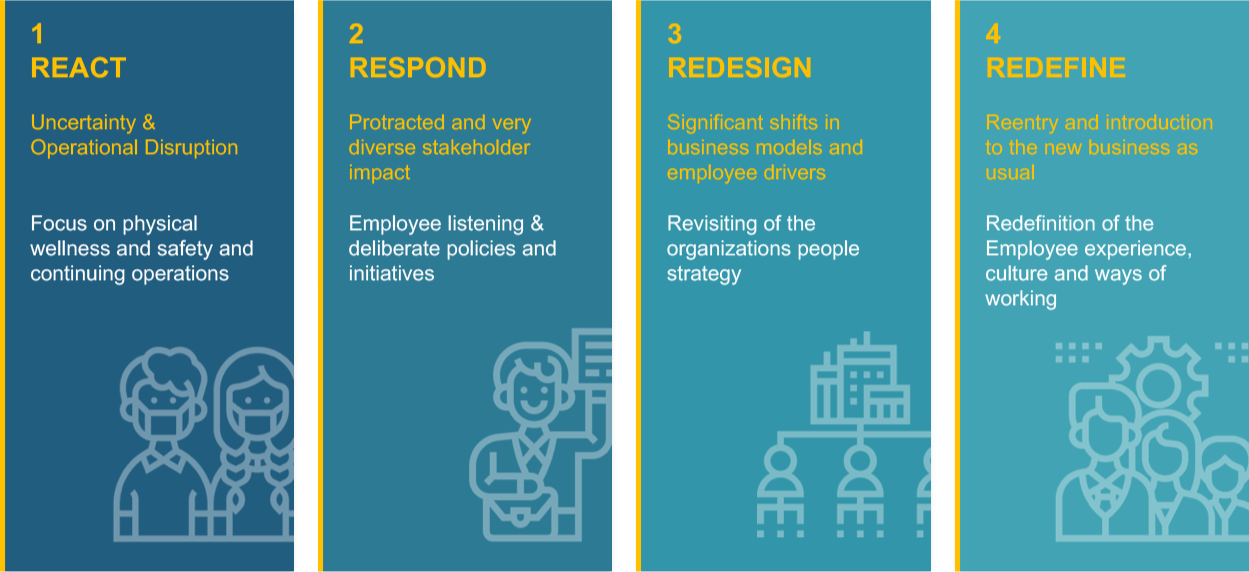
Earlier interviews by Acumen Strategy Consultants with a number of organizational leaders indicated that many companies appear to have parked themselves within the Respond stage given the uncertainty of things to come.
But now, with the emergence of what we can call a renewed business as usual, corporate leaders must carry on armed with key learnings from a global health crisis that shocked and crippled a world that was in the midst of making major digital strides.
These learnings are underpinned by the basic insight that in a crisis and change scenario, you go back to basics and the foundations of an organization must be solid to survive.
As we plan for the future, a review of these learnings and the organization's foundations are critical to establishing the right strategy for our people.
Three Challenges
Global experts who were ahead in the recovery journey pointed to three challenges and considerations in the Redesign and Rebuild stages.
Challenge 1: Revisiting our beliefs given the new employee realities to protect and strengthen culture
This is a challenge because increased employee fragmentation and unconscious bias are expected by-products of the prolonged pressure and many changes. Because of this fragmentation, policies are no longer one size fits all. The pandemic prompted a deeper “humanization” of the employee and a significant divergence of needs and motivations.
As a company, the impetus is to bring up the right beliefs, values and norms that will cultivate the corporate culture needed for business growth.
How do we do this?
Corporate leaders must listen more deeply to truly understand different employee needs and what drives them.
Once we understand, we need to reflect and review what matters to the company, what matters to employees, and what these mean for the prevailing corporate belief system.
Challenge 2: Finding the balance between wellness and productivity given the new work modalities
This is a challenge because, again, it is no longer one size fits all.
Furthermore, the emergence and abundance of virtual roles have created new career paths and opportunities for many.
Companies now have to be intentional in developing their ‘Employee Value’ proposition to acquire and retain talent.
This means putting a strong focus on employee experience as productivity comes with engagement and worker satisfaction.
What is required nowadays is listening often through more frequent dialogue with employees.
A wider array of choices must also be put on the table such as the
personalization of benefits and providing the option to create bespoke wellness assistance programs.
Corporate leaders should also aim for sustainable productivity, which means easing the pressure to be overly productive everywhere and all the time.
Challenge 3: Defining and building the team of the future—employee, leader, manager—finding the right mix for your human capital to ensure positive business performance
This posts a challenge because of two things. First, everything is evolving. While role names may be the same, expectations, ways of working and skill sets needed to succeed are not. And secondly, in this empowered and hybrid workplace, where there is little interaction beyond the immediate team, it will be the middle or line manager who will spell the difference between engagement and attrition.
Setting teams up to succeed takes several steps: Reassess, Retool, Re-skill.
The new ways of working and value delivery will require a reassessment of the organization’s design criteria and structure to ensure teams are set up effectively to support the company’s new strategies and plans.
As roles and expectations evolve, so must people’s capabilities. Soft skills related to managing change and flexibility such as intellectual curiosity, critical thinking, strategic decision making, innovation, communication and collaboration are must-haves moving forward.
This needs to be done mindfully, in a deliberate system of retooling so members help rather than burden teams.
In designing the workplace of the future, corporate leaders must keep in mind that having an agile people strategy is equally critical as having an agile business plan.
Redesigning policies, the workplace and workplace etiquette will be a continuous trajectory rather than complete inflection.
Having a test, learn, adapt mindset will be important in this continuing journey of transformation for everyone.
Acumen's tools and competency will take you on a step-by-step process that will bring to light the unique key aspects that will help you set up a company that is well-grounded and dynamic. To learn more about
Acumen's Organization Transformation service, contact us today.