
Insight
The hardest part of strategy is rarely generating options. It is narrowing them. A leadership team can usually name more worthwhile things to do than it has the capital, attention, or time to do well, and the work that separates a real strategy from a long to-do list is the discipline of distilling those many demands into a few priorities the whole organization can carry. BPI MS Philippines, the non-life insurance joint venture of BPI and Mitsui Sumitomo, came to Acumen facing exactly that challenge.
It is a situation most multi-department organizations recognize. When teams are not aligned, the instinct is to add — another initiative, another goal, another committee to coordinate the others. The harder and more useful move is to subtract: to decide which few priorities the organization will actually pursue, and to make those choices in a way the whole leadership team can stand behind. That is the work this engagement set out to do.
The ambition
BPI MS Philippines is a major player in the insurance industry, and it had set a clear organizational goal: to unify all of its departments around shared accountabilities and streams of work. The company wanted its teams pulling in the same direction, with clear ownership of the work that mattered most.
The challenge
The obstacle was not ambition but alignment. BPI MS did not have a unified, strategic direction or a common direction across the organization, in part because there was no venue to discuss and create alignment around what are the critical enablers and who will be accountable. Departments could each be working hard without being certain they were working toward the same few things. The leadership team needed to distill a clear set of priorities that could be cascaded through the organization, and it lacked a clear yearly roadmap of projects to anchor the work. Each of these is a version of the same problem: a lot of activities, not enough shared focus, and no agreed mechanism for deciding what came first.
The approach
Preparation is key. Acumen began with a set of discovery activities. Before any priorities were set, the team ran a comprehensive discovery process — interviews with executives and a survey of all BPI MS employees — covering clarity of direction, roles, ways of working, capacity, and culture. Each dimension answered a different question: whether people understood where the company was going, whether roles and accountabilities were clear, whether the way work moved through the organization helped or hindered it, whether the company had the capacity to deliver, and whether the culture would carry the change. Taken together, they gave the leadership team a candid baseline to plan against, rather than a set of assumptions. That groundwork mattered, because a leadership team can only make defensible choices once it shares an honest picture of where the organization actually stands.
The Framework
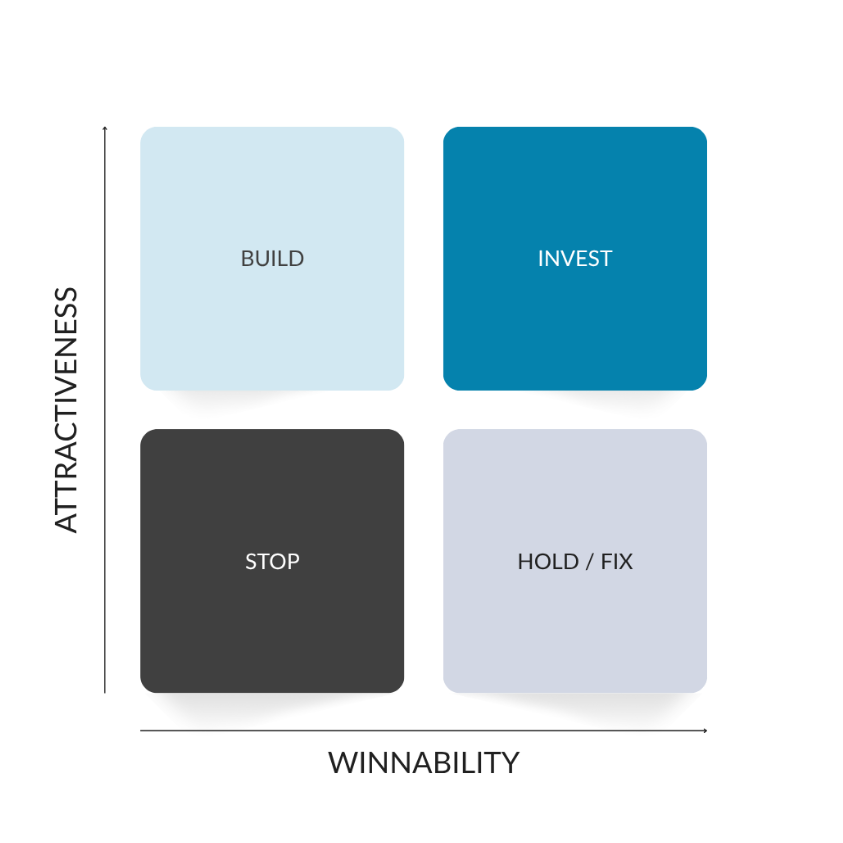
With that picture in hand, Acumen facilitated a strategic planning session with the leadership team to discuss and prioritize investment opportunities across all segments, applying Acumen's Strategic Choice Matrix to evaluate each opportunity. The Matrix is an objective, repeatable methodology that assesses
market attractiveness against
organizational winnability—how worthwhile an opportunity is to pursue relative to the organization's ability to win it—across both current and future opportunities. Used in a room of cross-functional leaders, it accomplishes something discussion alone cannot: it evaluates every opportunity against a common standard, allowing investment decisions to be guided by evidence rather than advocacy.
“Acumen's biggest value add is going through the details in a framework with a guided process to put clarity in ownership on each of the initiatives, and facilitation of the cross-functional discussion.”
— Marie Raymundo, Consultant
The choices
From that evaluation, two sets of choices followed. Where-to-Play strategies defined the commercial growth pathways the company would pursue and plan for — the segments and opportunities worth the organization's investment. How-to-Win strategies aligned the leadership team on the critical five-year commercial and enabler priorities required to meet its financial and non-financial goals — what the company would build and strengthen in order to compete where it had chosen to play. Together, they converted a broad field of possibilities into a defined, defensible set of commitments, each with an owner.
The result
The outcome was restored alignment on the roadmap to achieve the ambition, carried by clear how-to-win commercial and enabler strategies. What the organization gained was not a document but a shared direction: a small set of priorities, with clear ownership, that every department could cascade and act on. The venue that had been missing — a structured way to put enablers and accountabilities in place — became part of how the leadership team worked, which is what turns a one-time plan into a way of operating. A roadmap that everyone helped shape, and can see their own accountabilities within, is far more likely to survive contact with the year than one handed down after the fact.
That is what subtraction looks like inside an organization. It is the same discipline as deciding where not to play, expressed as focus: distilling many competing demands into the few priorities worth the whole organization's energy.
“Acumen's biggest strength is that even with only a one-day workshop session, Acumen provided many action items.”
— Yusuke Takamura, President
The same discipline, for your team
What stands out about this engagement is how quickly clarity followed once the method was in place. The choices were defensible because they rested on a shared standard, and they were actionable because ownership was clear from the start.
If your leadership team is making where-to-play choices this planning season, this is the conversation we have. Explore Acumen's
Long-term Strategy Development.