
Insight

Still relying on tactical marketing frameworks and approaches? Well, there is a familiar rhythm in how many organizations pursue growth.
A new campaign launches.
A pricing tweak is introduced.
A promotional push goes live.
The numbers move, sure. Sometimes up, sometimes not, sometimes in a way we’d rather not experience, and the cycle just keeps going. The focus is immediate, tactical, and often anchored in variations of the classic “5Ps”: product, price, place, promotion, and people.
Of course, there is nothing inherently wrong with these tools. But on their own, they are not enough.
Because lasting, sustainable growth rarely results from tactics alone. It is built from something deeper, something structural.
Too many organizations chase quick wins while overlooking the foundations that make those wins sustainable. Often, these organizations will optimize campaigns without aligning strategy. They push for revenue without strengthening the systems that support it. They invest in visibility without building the internal clarity that gives that visibility meaning.
This is the gap that Acumen’s Enduring Success Model is designed to address.
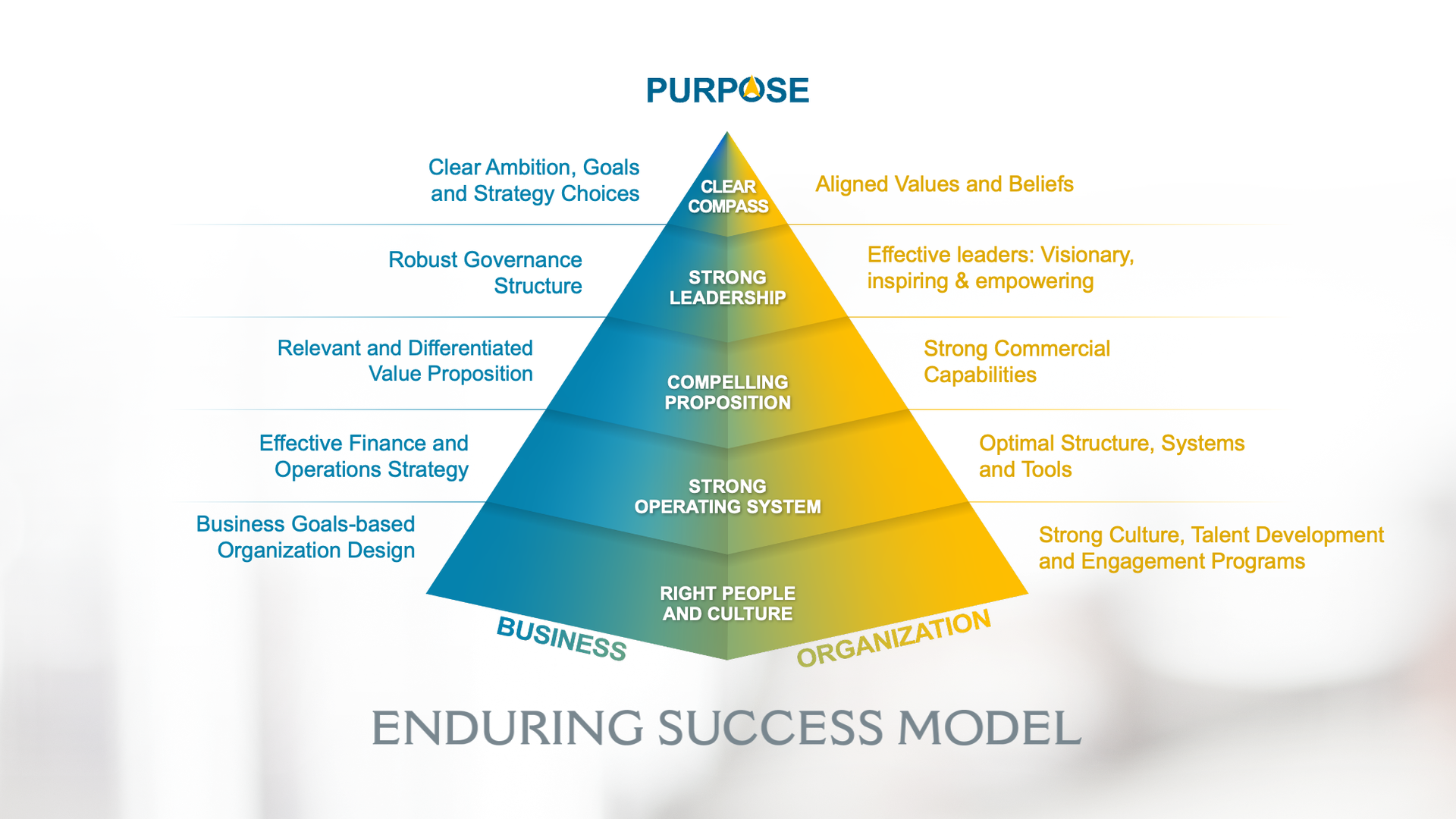
Rather than focusing on surface-level interventions, the model reframes growth as the product of five interconnected layers:
- Clear Compass
- Strong Leadership
- Compelling Proposition
- Strong Operating System
- Right People and Culture
Together, these elements form the infrastructure of enduring success. One that does more than produce successful results; it also sustains them in the long run.
Clear Compass: Setting Direction That Holds
At the center of every successful organization is clarity.
Clarity of purpose. Ambition. Clarity of the choices that define where to play and how to win.
Without this kind of clarity, even the most capable teams drift.
A “Clear Compass” does more than articulate a vision. It provides a roadmap against which every decision can be measured.
Should the company enter a new category? Expand into a new market? Invest in a new capability?
These are not isolated decisions, after all. They are strategic choices that shape the business's trajectory. And when the compass is clear, alignment follows. Resources are allocated with intent. Teams understand not just what they are doing, but why. Progress becomes actually measurable in a way that makes tangible sense.
Without that kind of clarity, organizations can fall into an unfortunate pattern of reactive decision-making, responding to short-term pressures rather than advancing a long-term agenda.
Strong Leadership: The Multiplier of Everything Else
Now, if strategy defines direction… leadership determines whether that direction is actually realized.
Leadership is not simply about authority. It is about influence. It’s about how leaders create trust, provide stability, and inspire confidence across the organization. Research from Gallup: How to Be a Better Leader highlights that “leadership accounts for a significant portion of team engagement, shaping how people experience their work and their organization.”
This matters because engagement, first and foremost, drives great performance.
Teams that trust their leaders? These are the teams that move faster, take ownership, and are empowered to navigate uncertainty with greater resilience. In contrast, weak leadership creates hesitation, misalignment, and, over time, disengagement.
Within Acumen’s model, Strong Leadership is embedded in how decisions are made and how accountability is structured. It’s an intrinsic part of how culture is reinforced.
Because even the best strategy will fail without leaders who can carry it forward.
Compelling Proposition: Why Customers Choose You
Picture a crowded market.
Is just standing there with your wares enough to get the audience you’re looking for? No, right? Same basic principle. And a “Compelling Proposition” defines why.
It answers a simple but critical question: why should a customer choose you over every other available option? According to Jason Weiland in Quicken's Business Value Proposition Guide, it’s the strong value proposition that communicates the uniqueness a business delivers, making it clear, relevant, and differentiated in the eyes of the customer. Thus, making that business the obvious choice.
But clarity is often harder than it seems.
Many organizations may describe what they offer without articulating why it is meaningfully different. The messaging can become generic. Positioning can become interchangeable. And in that environment, competition shifts toward price rather than value.
What can resist that pull? A compelling proposition.
It connects ‘customer need’ with strong business capability in a way that is both distinct and defensible. It is not just a statement—it is a commitment that shapes product decisions, marketing strategy, and customer experience.
When done correctly, as shown by Acumen’s successes, this is what builds preference.
Strong Operating System: Turning Strategy into Execution
If strategy sets the direction and execution determines the outcome, what bridges the two?
A “Strong Operating System”, that’s what.
It encompasses the structures, processes, and capabilities that allow an organization to deliver on its ambitions. Finance, operations, and commercial functions are not separate engines. They are interconnected systems that must work in sync.
Commercial excellence, in particular, plays a critical role. Organizations that align their go-to-market strategy with operational capability are better positioned to drive revenue and sustain growth. This requires more than periodic improvement. It demands continuous capability building—refining how the organization prices, distributes, sells, and delivers value.
Without a strong operating system, even the most compelling strategy remains theoretical.
With it, execution becomes consistent, scalable, and resilient.
Right People and Culture: The Foundation Beneath Everything
No system, no strategy, and no proposition can succeed without the right kind of people who can bring them to life.
The “Right People and Culture” are what anchor the entire model.
Organizational design is not just about structure. It is about alignment—ensuring that roles, processes, and incentives support the strategy rather than work against it. When people understand their role in the broader system, collaboration improves. Decision-making becomes faster. Innovation becomes more natural.
Culture, in this sense, is not abstract. It is expressed in everyday behavior—how teams communicate, how leaders respond to challenges, and how success is defined.
Organizations that invest in this layer create environments where performance and engagement reinforce each other. Those who neglect it often find themselves solving the same problems repeatedly, without addressing the root cause.
How Consultants Enable Enduring Success
The value of a framework is more accurately observed in its application. Theory can only go so far, after all.
In practical application, consultants play a critical role. Not as external observers but as partners embedded in the process. At Acumen Strategy Consultants, for example, consulting is not limited to diagnosis. Here, it is about facilitation, alignment, and capability building.
Teams work across functions, bringing together perspectives that can often be fragmented within the organization. Expert consultants from Acumen can challenge assumptions, introduce structure, and guide decision-making in a way that is both objective and grounded in experience.
Most importantly, they transfer knowledge.
With consultants like these, the goal is not dependency. It is self-sufficiency.
By the end of an engagement with this model implemented, the organization is not just equipped with a strategy. Rather, they have the capability to refine and execute that strategy over time.
It’s this that turns consulting from a short-term intervention into a long-term investment.
Quick Wins or Enduring Success: It’s Your Choice
In a business environment defined by speed and constant change, the temptation to prioritize quick and easy wins is understandable.
But quick wins, on their own, do not build lasting success.
They create some movement, sure, but often these quick wins can’t be done as solutions for the long run. There’s no enduring, sustainable progress.
Acumen’s Enduring Success Model offers an alternative. It shifts the focus from isolated tactics to integrated systems. From short-term gains to long-term value.
From fragmented effort to aligned execution.
The benefits speak for themselves.
There’s stronger employee engagement. Clearer strategic direction. More differentiated positioning. And ultimately? Yes, more sustainable growth.
So do these building blocks matter? Maybe the better question is whether organizations are willing to invest in them.
Because at the end of it all, growth is not just about what you do next.
It is about what you build now and how you can make it last.
Ready to move beyond short-term wins and build a business designed for lasting success?
Let’s talk and build your sustainable future over at Acumen Strategy Consulting.
Quick wins feel good. But they don't build lasting organizations. Discover the five interconnected layers behind Acumen's Enduring Success Model — and why sustainable growth starts from the inside out.